Table of contents
For all the conversation that has accumulated around the new Ellington release at Jumeirah Islands, the more useful exercise is to decode it. What does the project actually offer, on what terms, at what cost, and in what relationship to the broader Dubai luxury market? An honest decode requires moving past the marketing layer and into the structural elements of the development, the four-level clubhouse, the lakeside apartment rarity, the construction-linked payment plan, the projected yield, and the Golden Visa alignment.
The Four-Level Clubhouse as the Central Asset
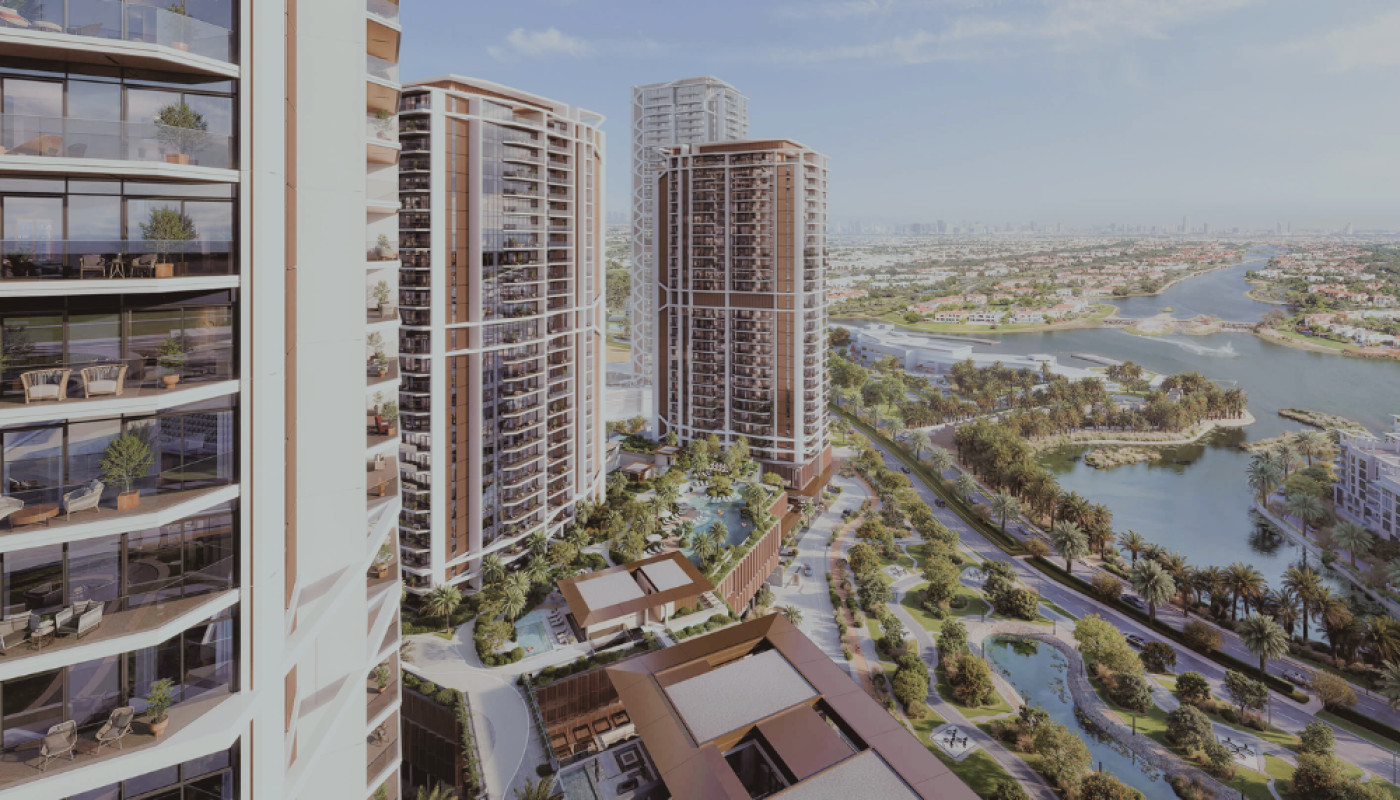
The most distinctive element of Eltiera Views is, by some distance, the four-level shared clubhouse. The facility, occupying a dedicated vertical block connecting the four towers, hosts a comprehensive wellness and lifestyle programme: a state-of-the-art gym, pilates and yoga studios, a dance studio, a residential cinema, a spa with sauna and treatment rooms, podcast and focus rooms, co-working spaces, and indoor lounges.
The depth of programming places the facility closer to a hospitality clubhouse than to the conventional Dubai residential gym-and-pool combination. Knight Frank’s Dubai Prime Residential Outlook has, in successive editions, flagged the depth of amenity programming as one of the clearest differentiators between standard residential product and what the publication has termed “branded-equivalent” residential. The four-level clubhouse at this project sits clearly in the second category.
The podium adds further density to the offer. Two infinity pools, one family and one adults-only, sit alongside a vitality pool, padel courts, an outdoor cinema, a kids’ garden, a pet area, BBQ pavilions, and EV charging infrastructure. The cumulative leisure and wellness footprint, distributed across the clubhouse and the podium, is unusually large for a development at this price band.
The Wellness Argument Decoded
The wellness programme is not, in this case, a marketing layer. The vertical clubhouse arrangement requires dedicated structural planning, dedicated mechanical infrastructure, and dedicated operational management. Service charges, set at approximately AED 21 per sqft per year, reflect the operational depth of the facility. For an owner of an 834 sqft one-bedroom apartment, the annual service charge sits in the region of AED 17,500, a figure that funds the wellness programming alongside the standard building operations.
JLL’s Living Insight reports have, in periodic commentary on the post-pandemic luxury market, identified wellness programming as one of the few residential elements where buyer willingness to pay has materially expanded. The clubhouse at Eltiera Views, accordingly, is best read not as an amenity expense but as a core component of the asset.
The Lakeside Apartment Rarity
A second structural element of the project is the rarity of its typology. Jumeirah Islands, since its delivery in the early 2000s, has hosted no apartment product. The community has been, in supply terms, a closed loop of villas. The introduction of apartment residences facing the saltwater lakes creates a category that has, until now, not existed.
Knight Frank’s research has, in past notes on supply-constrained Dubai postcodes, observed that the introduction of new typology into an established community tends to support pricing for several cycles after delivery. The reasoning is straightforward. Buyers seeking the address but unable or unwilling to commit to villa capital outlay have, historically, been excluded from the community. The arrival of apartment product activates that latent demand, and the resulting absorption tends to anchor pricing at the upper end of the local benchmark.
The lakeside positioning of the four-tower development at Jumeirah Islands is itself a structural element of this rarity. Saltwater lake frontage at Jumeirah Islands has been an exclusively villa-side asset for two decades. The new towers extend that frontage into the apartment category for the first time.
The 70/30 Payment Plan Decoded
The construction-linked payment plan, structured at 70/30, requires careful reading. Buyers commit 20 percent at booking, 50 percent across nine construction milestones, and 30 percent at handover in Q4 2029. The Dubai Land Department’s 5 percent registration fee sits in addition.
This structure differs from the more aggressive 60/40 or 50/50 plans that have characterised some recent Dubai launches. The relatively high handover tranche, at 30 percent, has clear implications for the buyer profile.
Why the Structure Filters Speculation
A high handover tranche aligns developer and buyer incentives until completion. It also limits the ease of pre-handover resale, because any buyer in the secondary market inherits the obligation to complete the handover payment. This dynamic filters out short-cycle speculators, who tend to favour plans with low handover tranches that permit easier flip-to-handover transactions.
For the project, the resulting buyer base skews toward end-users and long-cycle investors. JLL’s broader UAE market commentary has identified this buyer mix as one of the more stable foundations for off-plan pricing through construction cycles, particularly in markets where speculative resale has historically contributed to volatility.
Cash Flow Planning
For buyers planning their capital deployment, the 70/30 plan offers a predictable schedule. The 20 percent booking deposit anchors the commitment. The 50 percent spread across nine milestones, with the handover in Q4 2029, distributes the construction-phase obligations over approximately three and a half years. The 30 percent handover tranche concentrates the final payment at delivery, when the asset becomes income-producing or owner-occupied.
For an investor entering at the one-bedroom price band of AED 2.1 million, the booking deposit is AED 420,000, the milestone tranches average approximately AED 117,000 per milestone, and the handover tranche is AED 630,000. The DLD fee of AED 105,000 is payable at booking and is, in practice, the additional capital line that buyers should account for.
Yield and Income Projection
Indicative rental yield for the project sits at approximately 5.3 percent, a figure consistent with the broader Dubai apartment market in 2026 but at the upper end of the range for established luxury postcodes. Jumeirah Islands, as a community, has historically demonstrated tight rental supply for any product type, and the apartment category being introduced is expected to absorb rental demand from professionals and families seeking the address without the villa commitment.
Bayut’s rental market data has consistently shown Jumeirah Islands as a high-occupancy, low-vacancy postcode. The arrival of apartment product is, accordingly, expected to find rental demand from a buyer pool that has been structurally excluded by the prior villa monoculture.
A Worked Yield Example
For a one-bedroom apartment purchased at AED 2.1 million, a 5.3 percent indicative gross yield implies annual rental income of approximately AED 111,000. Service charges at AED 21 per sqft, applied to the 834 sqft upper one-bedroom configuration, sit at approximately AED 17,500 annually. Net yield, before tax and management costs, sits in the region of 4.5 percent. Dubai’s 0 percent income tax and 0 percent capital gains tax regime applies, meaning the gross-to-net spread is driven primarily by operating costs rather than fiscal extraction.
These figures are indicative rather than guaranteed. Knight Frank, JLL, and Bayut each publish more granular yield data periodically, and prospective investors should reference the most recent available benchmarks before committing.
The Golden Visa Alignment
The Dubai Golden Visa programme, set at an AED 2 million property qualifying threshold, aligns directly with the project’s entry price band starting at AED 2.1 million. Henley & Partners has, in its periodic commentary on residency-by-investment programmes, identified the Dubai Golden Visa as one of the most actively used residency pathways in the current cycle, particularly for buyers in the AED 2 million to AED 5 million property bands.
The ten-year renewable visa offers residency for the principal investor and immediate family members, with limited residency requirements compared to other major global programmes. For overseas buyers, this combination of yield, capital gains exemption, and residency mobility positions Dubai property at the upper end of the global luxury investment comparison set.
For the official Eltiera Views brochure, the alignment between the qualifying threshold and the entry price band is deliberate. The one-bedroom apartments are sized and priced to support Golden Visa applications, and the two-bedroom and three-bedroom apartments comfortably exceed the threshold. The strategic positioning of the price band, in effect, expands the addressable buyer pool to include the global mobility segment in addition to the traditional Dubai investment segment.
Freehold Status and Foreign Buyer Access
Jumeirah Islands sits within Dubai’s freehold zones, meaning the apartments are available to foreign buyers without nationality restriction. This freehold status, combined with the 0 percent income tax and 0 percent capital gains tax regime, places Dubai in a globally competitive position for high-end residential investment.
JLL’s Living Insight publications have, in successive editions, framed Dubai as one of the few global luxury markets where the fiscal regime, freehold access, and residency programme combine to produce an unusually favourable matrix for foreign buyers. The structural framework, applied to Ellington’s latest design-led address, supports the project’s positioning as a globally accessible asset rather than as a domestically constrained one.
Specifications Decoded
The apartment specifications themselves deserve careful reading. The floor-to-floor height of 3.6 metres is unusually generous for Dubai mid-luxury, and translates into floor-to-ceiling glazing of meaningful proportion. Large-format beige tiles and milky-shade wall finishes create the calm interior register that has become an Ellington signature.
The G + 3 podium + 26 residential floor configuration, per tower, allows the developer to concentrate amenity programming on the lower podium levels while distributing the residential floors above the leisure activity. The four interconnected towers share the clubhouse and podium, producing the cumulative scale that supports the depth of the amenity offer.
The apartment mix spans one-bedroom homes of 796 to 834 sqft, two-bedroom apartments of 1,221 to 1,285 sqft, two-bedroom-plus-study apartments at 1,405 sqft, three-bedroom apartments at 1,672 sqft, and three- to four-bedroom penthouses ranging from 5,509 to 5,985 sqft. The mix is weighted toward the one-bedroom and two-bedroom categories, reflecting the demographic the project is most clearly designed to serve.
A Reference for the Cycle
What the decode ultimately reveals is a project assembled with structural coherence across the elements that matter most for the 2026 Dubai market. The amenity programming aligns with the broader shift in buyer expectations. The lakeside positioning addresses a structural undersupply. The payment plan filters for conviction buyers. The yield projection sits within a credible range for the postcode. The Golden Visa threshold alignment expands the addressable buyer pool. The freehold status supports global access.
Knight Frank, JLL, and Henley & Partners each, in different ways, frame the current Dubai cycle as one defined by structural rather than speculative demand. The project, on the evidence of its design, pricing, and structure, has been engineered to serve precisely that demand. Whether the second-phase release of towers three and four will price in the absorption pattern of the first phase is the open question that the rest of 2026 will answer. The decode, in the meantime, points toward a project that has been built with unusual rigour for the cycle it has entered.
Similar articles